What Are the Top Marine Fender Types in 2026?
In 2026, choosing Marine Fenders is less about finding one universal winner and more about matching protection to actual berthing conditions. Vessel size, approach speed, tidal range, quay layout, and maintenance capacity all affect the choice. A compact workboat at a sheltered berth has different needs from a large vessel using a busy terminal. Fit matters most.
This guide introduces common options, including pneumatic, foam-filled, cylindrical, arch, cone, and cell fenders. Each design offers different advantages in energy absorption, installation, durability, and upkeep. For example, pneumatic fenders can suit changing tides and ship-to-ship transfers, while fixed rubber systems may be practical for quay walls with predictable contact points. These are useful patterns, not guarantees; site conditions can change the outcome.
The following sections compare how these types perform and what to consider before specifying them. We will look at berthing energy, facing materials, layout, inspection needs, and lifecycle cost, rather than judging products by appearance alone. Product data and engineering review matter, especially where vessel traffic or impact loads are high. There is no shortcut. Even a well-chosen fender can underperform if it is poorly positioned or maintained. That detail is easy to overlook.
How Marine Fenders Absorb Berthing Energy
Marine fenders protect vessels and berths by controlling the force created during contact. As a ship moves toward a quay, its kinetic energy must be absorbed or redirected. A fender compresses under load, converting much of that energy into deformation and heat. The vessel slows. The berth experiences less impact.
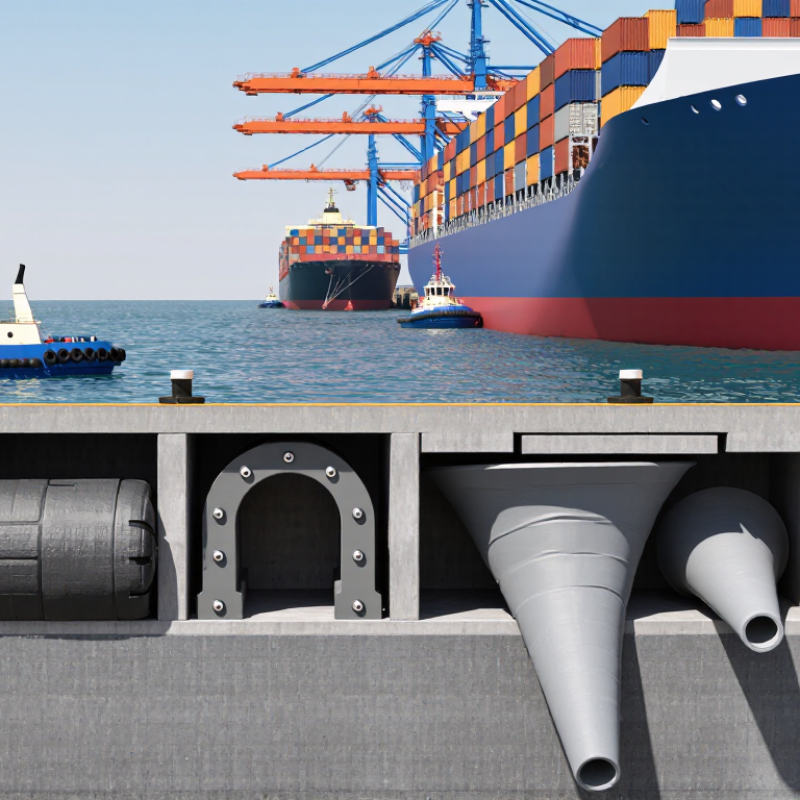
Different designs manage this process in different ways. Cone and arch fenders can provide substantial energy absorption within a compact footprint. Cylindrical fenders suit simpler contact conditions, while foam-filled and pneumatic types can accommodate changing water levels or varied vessel shapes. Selection depends on vessel mass, approach speed, berthing angle, tidal range, and available space. No type is best everywhere.
Performance is not just a catalog figure. Engineers compare energy absorption with reaction force, which is the load transferred to the supporting structure. They also account for temperature, repeated compression, installation details, and aging.
A fender tested under one set of conditions may behave differently when struck off-center or at an unexpected angle. It is easy to oversimplify this. Real berthing rarely follows a perfect line. Inspecting the rubber, chains, panels, and anchors helps reveal whether the system still responds as intended. Even small cracks or loose hardware deserve attention.
Fixed Fender Types: Cylindrical, Cone, Cell, and Arch
Cylindrical, cone, cell, and arch fenders are common fixed options for quay walls and berthing structures. A cylindrical fender compresses as a vessel comes alongside, providing a simple contact surface for lighter berthing duties. Its round profile can suit varied contact angles, though performance depends on size, rubber compound, and installation. Small details matter.
Cone fenders are often selected where substantial energy absorption is needed within a compact footprint. Their tapered shape can maintain useful performance under angled compression. Cell fenders use a broad, hollow rubber body and are commonly paired with a front panel to spread contact loads across a vessel’s hull. Both types need properly designed anchors and enough clearance for compression. A drawing alone may hide a poor fit.
Arch fenders have a curved profile and can work well in straightforward, space-conscious installations. They are generally less complex, but their capacity may not suit every vessel or berth. Selection should account for vessel displacement, approach speed, tide range, contact angle, and the supporting structure’s strength. Measurements at an active berth are useful, yet they do not replace engineering calculations. That part is easy to underestimate.
Floating Fender Types: Pneumatic, Foam, and Modular Designs
What Are the Top Marine Fender Types in 2026?
Floating fenders protect vessels and berth structures while moving with changing water levels. Pneumatic models use compressed air inside a reinforced rubber body. They absorb impact and suit ship-to-ship transfers or exposed berths. Operators must check air pressure, valves, and the outer cover. Small leaks matter.
Foam-filled fenders use a resilient core beneath a tough outer skin. They need no inflation and remain buoyant after surface damage, but can be heavy to handle. Modular designs join replaceable floating sections to fit different berth shapes. Their connections need regular inspection, especially where waves cause repeated twisting. No type fits every site. Vessel size, approach speed, water conditions, and maintenance capacity all affect the choice.
Tips: Measure the berth and check the fender’s rated energy absorption before ordering. Look for scuffs, loose connectors, or changes in buoyancy during routine checks. A fender that looks substantial may still be poorly matched to the impact load. It is easy to overlook that detail.
How Fender Types Compare in Energy Absorption and Durability
What Are the Top Marine Fender Types in 2026?
How Fender Types Compare in Energy Absorption and Durability
Choosing a fender means balancing energy absorption, reaction force, space, and service life. Cell and cone fenders suit many fixed berths because their compact rubber bodies absorb substantial impact energy. Cone designs can offer strong performance across different approach angles, while cell types are often simpler in shape. Neither wins everywhere. Actual capacity depends on dimensions, backing panels, and installation conditions.
Pneumatic fenders compress as air inside them is displaced, making them useful for floating vessels and changing water levels. They spread contact across a broad surface, but their outer layers need checks for abrasion, pressure loss, and aging. Foam-filled fenders resist punctures and can remain buoyant after surface damage, though their weight and initial cost may be higher. Cylindrical and arch fenders are often practical for lighter impacts or limited installation space. A tidy chart cannot capture every berth.
Tips: Compare energy absorption and reaction force at the same design conditions. Check tidal range, vessel approach speed, and available mounting space. Inspect rubber for cracks and pneumatic units for pressure loss. Maintenance records matter. So does installation quality. Even a well-sized fender can wear unevenly if contact repeatedly occurs off-center.
Choosing the Right Marine Fender for Each Berth in 2026
Choosing the right marine fender starts with the berth, not a product list. A deep-water container berth faces different loads from a tidal ferry landing or a small repair quay. PIANC’s Guidelines for the Design of Fender Systems explains how designers estimate berthing energy using vessel displacement, approach speed, berthing angle, and other correction factors. Check these inputs against actual vessel records where possible. Assumptions can be wrong.
Cone and cell fenders suit many heavy-duty berths, where high energy absorption and controlled reaction forces matter. Arch and cylindrical fenders can work for lighter vessels or simpler quay layouts. Pneumatic fenders are useful for ship-to-ship operations and locations with changing water levels. The hull contact area matters, too. A compact fender may concentrate pressure on an older quay wall.
Traffic patterns deserve attention. UNCTAD’s Review of Maritime Transport 2024 reports that seaborne trade grew 2.4% in 2023. More cargo does not automatically mean larger design vessels, but berth traffic can change. Check vessel size, approach speed, tide range, and available wall strength before selecting a system. Leave room for inspection and replacement. I would revisit the assumptions after collecting a season of berthing data; first estimates are rarely perfect.
Top Marine Fender Types in 2026: Typical Berth Applications
This chart summarizes common applications for six widely used marine fender types. A value of 1 indicates a typical application; 0 means it is not a primary typical application, not that the fender cannot be used there. Final selection depends on vessel energy, berth structure, operating conditions, and the fender manufacturer's design data.